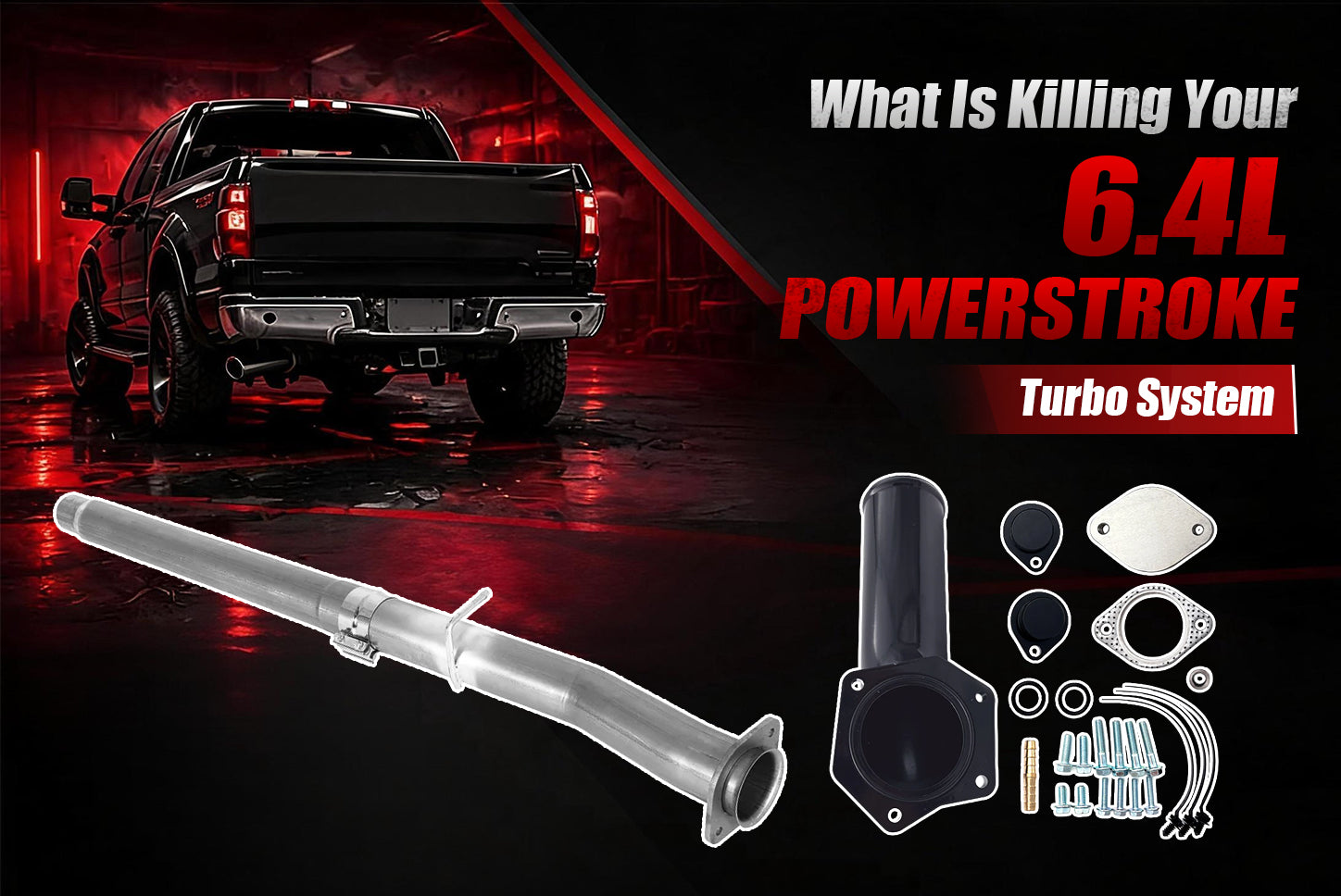

For dedicated owners of 2003-2007 Ford F250 and F350 Super Duty trucks, the 6.0L Powerstroke diesel engine remains an absolute benchmark of heavy-duty towing muscle. However, underneath its massive work capacity lies a highly restrictive factory breathing infrastructure that turns into a mechanical roadblock as the miles accumulate. When forced to survive under heavy daily hauling and intense thermal pressure, the original equipment catalytic converter and muffler act like a tight structural plug in your exhaust line. Over years of daily driving, internal carbon soot packs tightly into these restrictive factory chambers, forcing your engine to fight against massive resistance just to expel spent gases.
The Silent Turbo Killer: Dangerous EGT Spikes and Airway Restricting Sludge
When your exhaust cannot flow freely due to factory bottlenecks, intense heat backs up directly into the manifold, driving your Exhaust Gas Temperatures (EGTs) straight into the danger zone. Prolonged exposure to these elevated thermal cycles puts incredible strain on your variable geometry turbocharger (VGT), causing the internal aerodynamic vanes to stick, bind, and eventually seize.
Simultaneously, a parallel airflow bottleneck unfolds on the fresh air side of the powertrain. The original factory cast intake elbow features structural restrictions that twist, disrupt, and slow down incoming clean air. This turbulent air environment starves your diesel cylinders of vital oxygen at lower RPMs, creating massive low-end turbo lag and destroying your daily throttle response. Left unaddressed, your heavy-duty powertrain is actively suffocating under its own trapped heat.
The Permanent Mechanical Remedy
Upgrading to a premium, precision-engineered metal delete configuration represents the most definitive mechanical solution to permanently eliminate these systemic breathing vulnerabilities. By completely isolating and clearing out the prone factory cooling and exhaust chambers, you establish an unobstructed system layout that permanently protects your internal engine valves from thermal warping and carbon liquid contamination.
Replacing these factory restriction failure points preserves the overall operational longevity of your truck, guarantees total peace of mind on the road, and delivers a night-and-day improvement in throttle response. Best of all, achieving this total under-hood transformation doesn't require a multi-thousand-dollar overhaul; you can completely restore your powertrain’s efficiency using rugged, industrial-grade metal hardware.
Heavy-Duty Upgrades: Eliminating 6.0L Powerstroke Restrictions
To permanently shield your high-pressure powertrain from dangerous backpressure and restrictive intake velocities, upgrading to solid steel and billet aluminum infrastructure is highly recommended. Below are the industry's premier structural upgrades, specifically engineered to correct these notorious Ford factory engineering oversights.
2003-2007 6.0L Ford Powerstroke 3.5" Cat & Muffler Delete Pipe
This 3.5" cat & muffler delete pipe completely removes the clogged factory catalytic converters and mufflers, establishing an unobstructed, free-flowing exhaust path that instantly relieves structural engine strain.

-
409 Stainless Steel Composition: Forged entirely from heavy-gauge, corrosion-resistant 409 stainless steel to deliver exceptional tensile strength and long-term structural integrity through endless intense heat cycles.
-
Backpressure Reduction: Significantly reduces restrictive backpressure and maximizes flow for a freer exhaust discharge, allowing the turbocharger compressor to spool effortlessly under load.
-
Aggressive Exhaust Tone: The straight pipe design completely unleashes the raw, iconic rumble of the diesel motor, delivering a louder, rawer, and more aggressive exhaust tone during acceleration.
-
Turbo Response & Power Boost: Removing the restrictive catalytic converters and mufflers allows horsepower to increase noticeably while delivering an immediate improvement in turbocharger response time.
-
Strict Vehicle Fitment Guide: Tailored strictly to fit 2003-2007 6.0L Ford F250 and F350 pickup styles. EXCEPTIONS: This kit explicitly will not fit the 2004 Ford F-250 Super Duty XL standard cab with the 6.0L diesel, nor will it fit the 2004 Ford F-350 Super Duty Lariat Crew Cab Pickup 4-Door.
2003-2007 6.0L Ford Powerstroke EGR Intake Pipe Intake Elbow
This high-velocity intake elbow replaces the restrictive factory entry tract, optimizing air delivery and ensuring your engine receives clean, high-density oxygen.

-
T-6061 Aluminum Material: Manufactured from high-quality T-6061 aluminum material, offering incredible corrosion resistance while dramatically increasing top-end strength and durability.
-
80% Airflow Expansion: Utilizes a smooth and unrestricted mandrel-bent tubing design, which effectively increases the fresh air flow in the intake pipe by a massive 80%.
-
O-Ring Seal Design: Engineered with a premium O-ring seal designed to handle any boost pressure without leaking, weeping, or pushing out under severe towing loads.
-
1/8-Inch NPT Ports: Features integrated 1/8 inch NPT ports installed directly into the aluminum body, providing an effortless, clean mounting location for auxiliary boost gauges or injection nozzles.
-
Pressure Tested Reliability: Fully welded and pressure tested to prevent internal scale from separating, ensuring an improved throttle response and long-term mechanical defense.
-
Broad Super Duty Compatibility: Engineered for exact vehicle fitment on 2003-2007 6.0L Powerstroke F250, F350, F450, and F550 Super Duty Diesel Turbo trucks.
Step-by-Step Diagnostic Guide: How to Confirm Exhaust and Intake Bottlenecks
Because excessive backpressure and intake restrictions happen entirely internally, you won't always spot the issue immediately. To prevent these factory blindspots from destroying your turbocharger vanes, perform this quick multi-point diagnostic inspection straight from your garage floor.
-
Monitor Your Boost Vanes: Connect an OBD2 scanner and monitor the VGT duty cycle. If the vanes are lagging or getting stuck under normal acceleration, high backpressure is causing carbon to bind the turbo assembly.
-
Inspect Your EGT Gauges: Watch your pyrometer closely during a heavy haul. If your exhaust gas temperatures climb rapidly past 1,300°F while maintaining normal speeds, your factory muffler and catalytic converter are clogged and acting as a heat dam.
-
Check for Oil-Soaked Intercooler Boots: Pop the hood and examine the hot-side intercooler pipe connections. Heavy oil saturation around the rubber joints indicates high crankcase pressure and turbulent intake restrictions are weakening your factory couplers.
-
Listen for Delayed Turbo Spool: If you slam the throttle and notice an unusually long, quiet delay before the turbo whistles and builds pressure, your restrictive original factory intake elbow is actively starving the engine of velocity.
Performance Integration & Long-Term Mechanical Protection
Optimizing the structural reliability of a heavy-duty pickup requires treating its breathing and cooling subsystems as a singular, highly synchronized ecosystem. Swapping out fragile factory infrastructure for a heavy-duty 3.5" cat & muffler delete pipe addresses more than just high exhaust temperatures under the hood. It acts as a comprehensive defense system that permanently eliminates carbon-soot restrictions, prevents turbulent airflow from starving your cylinders, and insulates your variable geometry turbocharger from blistering heat cycles.
Establishing complete powertrain dependability under severe towing stress relies heavily on isolating these high-heat zones. Eliminating restrictive, failure-prone factory components with an upgraded 6.0l powerstroke egr intake pipe ensures uncompromised intake velocity, maintains stable core engine operating parameters, and drops EGTs significantly. By managing internal airflow restrictions and safeguarding the vehicle against recurring thermal stress, truck owners can secure consistent torque output, protect critical turbocharger components, and unlock the true structural durability their heavy-duty rig was engineered to provide.
Conclusion
Chasing down a sluggish throttle response, dealing with elevated operating temperatures, and worrying about fluctuating boost metrics doesn't have to be a permanent reality for your Super Duty truck. While leaving a clogged, restrictive catalytic converter and a choked original intake elbow untouched guarantees chronic flow resistance and premature turbo failure, upgrading to high-grade steel and CNC-machined aluminum hardware secures your investment.
Is Your 6.0L Powerstroke Dying From High Backpressure? Don't wait for a completely plugged factory exhaust or a sudden low-boost code to leave your heavy trailer stranded on a steep highway grade. Take definitive charge of your truck's mechanical longevity today without breaking your budget. To find the ultimate CNC-machined bypass configurations, rugged 409 stainless steel straight pipes, and vehicle-specific hardware tailored strictly to your powertrain, explore the complete professional catalog over at www.dieseltok.com. Give your platform the unrestricted breathing efficiency and commercial-grade durability it needs to conquer the road.
Frequently Asked Questions (FAQ)
1. Why should I choose a 3.5" cat & muffler delete pipe over a standard aftermarket muffler?
A standard replacement muffler still contains internal baffles and packing that introduce physical flow restrictions and trap heat. A dedicated 3.5" cat & muffler delete pipe utilizes an entirely open straight pipe design that delivers zero flow resistance, allowing your engine to drop EGTs rapidly and maximize exhaust velocity.
2. Will installing a new intake elbow fix a sluggish throttle response on my 6.0L Powerstroke?
Yes. The original factory intake elbow features restrictive internal contours that slow down incoming air. Upgrading to an aftermarket aluminum intake elbow expands fresh air flow by up to 80% using smooth, mandrel-bent curves, which immediately eliminates low-end turbo lag and sharpens throttle response.
3. Does the 3.5" cat & muffler delete exhaust system fit all 2004 Ford Super Duty trucks?
No, there are precise exceptions you must watch out for. This exhaust system fits standard 2003-2007 pickup beds but explicitly will not fit a 2004 Ford F-250 Super Duty XL standard cab with the 6.0L diesel engine, nor will it fit a 2004 Ford F-350 Super Duty Lariat Crew Cab Pickup 4-Door.
4. What is the benefit of having 1/8 inch NPT ports installed on the egr intake pipe?
These pre-installed 1/8" NPT auxiliary ports provide a clean, highly convenient, and safe mounting location for external sensors. This allows you to hook up mechanical boost gauges, nitrous systems, or water-methanol injection kits directly into the high-velocity air stream without drilling or welding your factory parts.
5. Is custom electronic tuning mandatory after removing the catalytic converter and muffler?
While a straight pipe mechanical modification on a 2003-2007 6.0L Powerstroke doesn't always trigger a severe limp mode like newer trucks, custom software tuning is highly recommended. Flashing an updated tune allows your ECM to optimize fuel metrics for the increased airflow and lower backpressure, maximizing your horsepower gains.
6. How does a straight pipe design protect my variable geometry turbocharger from failing?
When the factory exhaust is choked by a clogged catalytic converter, extreme backpressure forces hot exhaust gases backward into the turbocharger. This excessive thermal exposure bakes the lubricating oil inside the turbo center section, forming hard carbon deposits that lock up the moving internal vanes. A straight pipe eliminates this backpressure entirely.