
The 6.0L’s Weakest Link
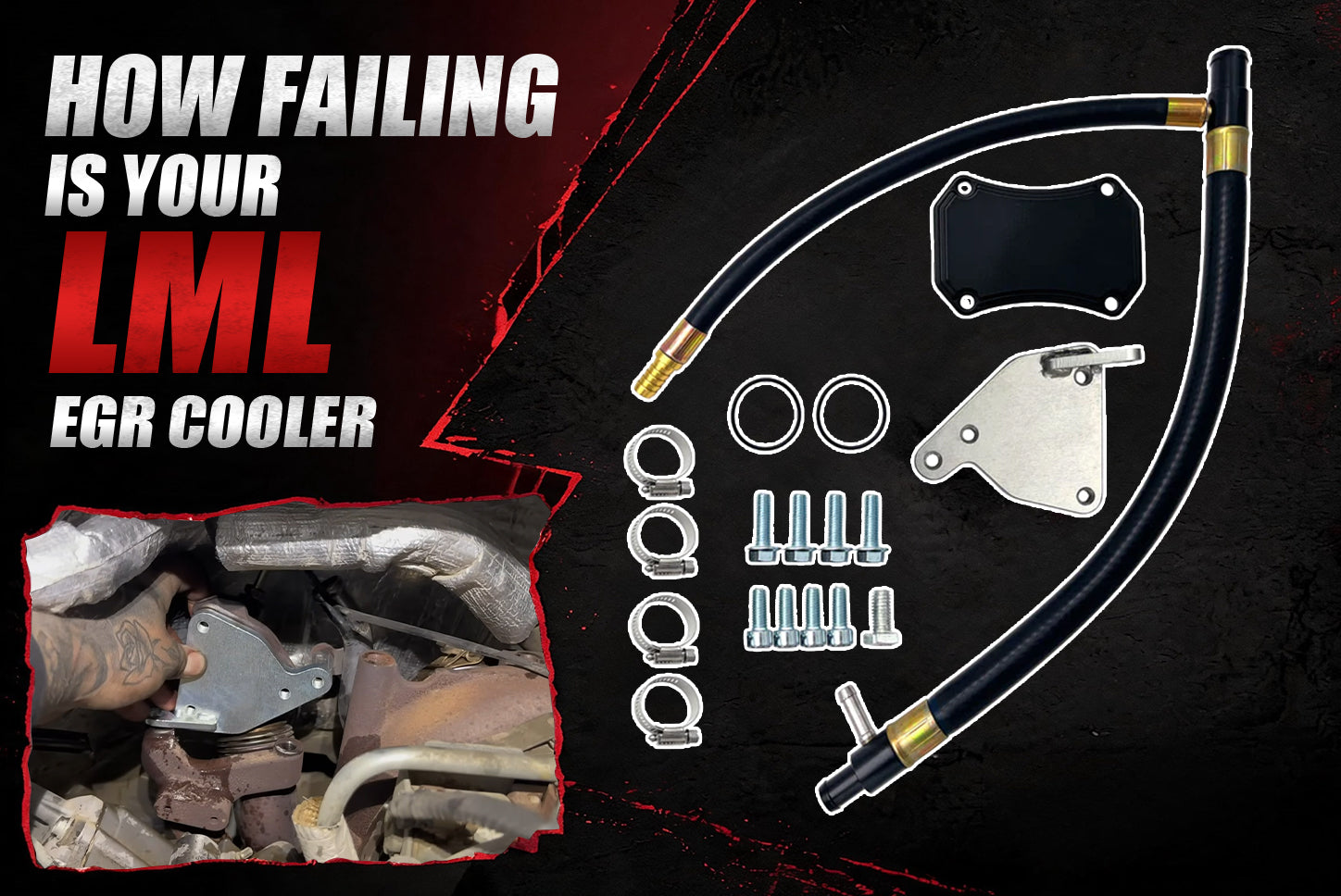
The 6.0L Powerstroke EGR cooler is a heat exchanger that routes hot exhaust gas through a bundle of small tubes surrounded by engine coolant. In theory, it cools the recirculated exhaust before it re-enters the intake. In reality, it’s a ticking time bomb.
Here’s why: the 6.0L’s factory oil cooler sits upstream of the EGR cooler. When the oil cooler clogs (and it will, thanks to Ford’s Gold coolant turning to silicate sludge), coolant flow to the EGR cooler drops. The tubes overheat, crack, and suddenly you have coolant pouring into your cylinders through the intake.
That’s how a $300 EGR cooler failure turns into a $4,000 head gasket job — and a truck that’s down for a week.
The domino sequence: Clogged oil cooler → restricted coolant → EGR cooler overheats → tubes rupture → coolant enters intake → cylinder hydrolock or head gasket failure.
5 Warning Signs Your 6.0L EGR Cooler Is Failing
Catch these early and you’re replacing an EGR cooler. Ignore them and you’re doing head studs.
1. White Smoke at Startup (That Smells Sweet)
This is the #1 tell. A healthy 6.0L diesel should puff minimal smoke on a cold start. If you see thick white vapor that hangs in the air and has a sweet, syrupy smell — that’s coolant burning in the combustion chamber.
How to check: Cold start in the morning. Stand behind the truck. If the smoke smells like maple syrup and doesn’t dissipate quickly like normal condensation, you’re burning coolant.
How to tell condensation (normal) from EGR cooler failure:
- Condensation is normal if the smoke is thin, dissipates quickly, has no smell, and only appears on cold or damp mornings — with no drop in coolant level.
- EGR cooler failure produces thick white vapor that hangs in the air, smells sweet (like syrup), happens even after the engine is fully warm, and is accompanied by a dropping coolant level.
2. Disappearing Coolant (With No Visible Leaks)
You’re topping off the degas bottle every few hundred miles but there’s no puddle under the truck. The coolant is going somewhere — and if it’s not on the ground, it’s going through the engine.
This is often the earliest sign, and it’s easy to miss because the leak is internal. A small crack in the EGR cooler tubes will sip coolant into the intake at a rate too slow to produce visible smoke but fast enough to drain your reservoir over a week of driving.
How to check: Mark your degas bottle level cold, drive 500 miles, check again cold. If it dropped more than 1/4 inch, you have an internal leak.
3. Puking from the Degas Bottle Cap
The degas bottle (coolant reservoir) cap is rated for 16 psi. When combustion pressure leaks past a cracked EGR cooler into the cooling system, it over-pressurizes the entire system. The cap becomes the path of least resistance — coolant sprays out from under it, leaving white residue streaks down the side of the bottle.
This is the emergency sign. If you see dried white coolant residue around your degas cap, stop driving. You’re one hard pull away from lifting a head.
How to check: Look at the degas bottle cap and the area around it. White chalky residue = combustion gas in your cooling system.
4. Unexplained Overheating Under Load
Your coolant temp gauge climbs when towing or climbing a grade, but the truck cools back down at idle. This can be caused by a partially clogged EGR cooler creating a flow restriction in the cooling circuit.
Often this happens alongside coolant loss, making it worse — low coolant + restricted flow = rapid overheating.
5. Wet or Sooted EGR Valve
Pull the EGR valve (two bolts, 5 minutes). If it’s wet with coolant or coated in wet, sticky carbon rather than dry soot, coolant is making it past the EGR cooler and into the intake stream.
How to check: Remove the EGR valve and inspect the valve face and the intake port beneath it. Dry black soot is normal. Wet, greasy, or sticky residue = coolant contamination.
Why the 6.0L EGR Cooler Is Worse Than Other Platforms
Every diesel with EGR has an EGR cooler. So why is the 6.0L’s so notorious?
-
Coolant type. Ford’s factory Gold (G-05) coolant degrades into a silicate gel that clogs the narrow oil cooler passages. Restricted oil cooler = restricted EGR cooler.
-
Upstream design. On the 6.0L, the EGR cooler receives coolant that has already passed through the oil cooler. When the oil cooler plugs, the EGR cooler starves first.
-
Thin-walled tubes. The 6.0L’s EGR cooler uses stainless steel tubes that are particularly susceptible to thermal fatigue cracking when coolant flow drops. Later designs (6.4L, 6.7L) addressed this with improved materials and flow paths.
-
No factory gauge warning. Unlike the 6.7L which monitors EGR cooler efficiency, the 6.0L has no warning system. By the time you notice symptoms, the cooler has already failed.
Diagnosis Flowchart: Oil Cooler or EGR Cooler?
Before you order parts, figure out which one failed. The symptoms overlap, but the test is straightforward:
Here’s the decision path:
- Delta under 15°F at 65 mph cruise → Your oil cooler is healthy. If you still have white smoke and coolant loss, the EGR cooler has failed on its own. Replace or delete it.
- Delta over 15°F → Your oil cooler is clogged. Since the EGR cooler was starved of coolant flow, it’s almost certainly damaged too. Replace or delete both at the same time.
How to run this test: Get the truck to full operating temperature. Drive at a steady 65 mph on flat ground for 10+ minutes. With a scan tool (Torque Pro, FORScan, or SCT), monitor ECT (Engine Coolant Temperature) and EOT (Engine Oil Temperature). If EOT is more than 15°F above ECT, your oil cooler is restricted and needs replacement regardless of what you do with the EGR system.
If the delta is normal but you still have white smoke and coolant loss, the EGR cooler has failed independently — which is less common but does happen.
The Fix: Risk It or Delete It?
Once an EGR cooler has failed, you have two paths:
Option A: Replace the EGR Cooler (Plus Oil Cooler)
- Replace EGR cooler with OEM or upgraded aftermarket unit
- Replace oil cooler (mandatory — don’t put a new EGR cooler behind a clogged oil cooler)
- Flush cooling system, switch to EC-1 rated ELC coolant
- Cost: $800–$1,200 parts + 8–12 hours labor ($2,000–$3,500 total at a shop)
- Risk: It will fail again. The 6.0L’s fundamental cooling design hasn’t changed. You’re buying time.
Option B: Delete the EGR Cooler
- Remove the EGR cooler entirely
- Install an EGR Cooler Delete Kit or a complete EGR Delete Kit (cooler + valve)
- Reroute the coolant line that fed the EGR cooler (included in the kit)
- Delete EGR function from the tune
- Cost: $150–$400 parts + 4–6 hours labor ($500–$1,000 at a shop)
- Risk: None — no more EGR cooler to fail, no more coolant-to-intake path
For most 6.0L owners: Deleting the EGR cooler is the more permanent, cost-effective solution. You eliminate the failure point entirely rather than replacing it with another component that shares the same design flaw. If the oil cooler is also clogged, address it at the same time.
What to Do If You Caught It Early
If you’re seeing early symptoms (slight coolant loss, occasional white puff at startup) and your oil cooler delta is still under 15°F, you caught it in the window where a simple EGR delete stops the damage chain before it hits your head gaskets. Here’s the play:
- Stop driving the truck or keep trips short and unloaded
- Order your delete kit — cooler delete minimum, full EGR delete recommended
- Change your coolant to an EC-1 rated ELC (Shell Rotella ELC, CAT ELC, or equivalent)
- Monitor oil cooler health — if the delta stays under 15°F, your oil cooler survived
- Install a coolant filtration system to catch residual casting sand and silicate debris
What Happens If You Ignore the Symptoms
Here’s how the damage escalates — and what it costs at each stage:
- Stage 1 — Slight coolant loss, occasional white smoke at startup. The EGR cooler has cracked but the leak is small. Fix: Delete kit, $150–$400. Done in a weekend.
- Stage 2 — Frequent degas puking, heavy white smoke. Combustion pressure is now pushing into the cooling system. The EGR cooler is fully ruptured. Fix: Delete kit plus oil cooler, $400–$800. Still driveway-doable.
- Stage 3 — Coolant in the oil (milky dipstick), engine misfire. The head gaskets are compromised. Fix: Head gaskets, ARP studs, and machine work. $3,000–$5,000. Cab has to come off.
- Stage 4 — Hydrolock on startup, bent connecting rod. A cylinder filled with coolant while the engine was off. Fix: Engine rebuild or replacement, $8,000+.
Stage 1 and 2 are fixable in your driveway with basic tools. Stage 3 requires pulling the cab. Stage 4 means a new engine. The cost difference between catching it at Stage 1 and letting it reach Stage 3 is roughly 10x.
Conclusion: The $200 Fix That Prevents the $4,000 Job
The 6.0L Powerstroke’s EGR cooler isn’t just an emissions component — it’s a single point of failure that, when it goes, can cascade into the most expensive repair these trucks face.
If your 6.0L is showing any of the five warning signs above, don’t wait. A $150–$400 delete kit installed over a weekend eliminates the failure point permanently. Wait until coolant has been blowing out your degas bottle for a month, and you’re looking at head studs, machine work, and a truck that’s down for weeks.
Grab our 6.0L Powerstroke EGR Delete Kit for a full delete (cooler + valve) or the EGR Cooler Delete Kit if you only need the cooler gone.

FAQ
What causes a 6.0L Powerstroke EGR cooler to fail?
Almost always, a clogged oil cooler is the root cause. The factory oil cooler’s narrow passages plug with silicate gel from degraded Ford Gold coolant, restricting coolant flow to the EGR cooler. Without sufficient coolant, the EGR cooler tubes overheat, crack from thermal fatigue, and leak coolant into the intake.
How do I know if my 6.0L EGR cooler is failing vs a head gasket?
The key distinction: an EGR cooler failure sends coolant into the intake, producing white smoke from the exhaust with a sweet smell, and coolant loss without external leaks. A head gasket failure sends combustion gas into the cooling system, causing degas bottle puking under load, coolant hoses that are rock-hard when hot, and often combustion gas bubbles visible in the degas bottle with the cap off. The two can happen together — one causes the other — but the diagnostic flow is: check for internal coolant consumption first (EGR cooler), then check for combustion gas in the coolant (head gaskets).
Can I just replace the EGR cooler without doing the oil cooler?
No. The oil cooler is almost always the reason the EGR cooler failed in the first place. Installing a new EGR cooler behind a restricted oil cooler guarantees a repeat failure — often within months. If you’re replacing the EGR cooler with another cooler (not deleting), the oil cooler must be done at the same time.
Will an EGR delete affect my 6.0L’s towing performance?
No, an EGR delete does not reduce towing capability. The 6.0L’s power output comes from fuel, air, and tuning — not from recirculated exhaust gas. Deleting the EGR removes a failure point and reduces intake air temperatures, which can actually improve towing reliability by keeping EGTs lower under sustained load.
How long does a 6.0L EGR cooler delete take to install?
An EGR cooler delete takes 4–6 hours for a DIY mechanic with basic tools. The intake manifold must be removed to access the cooler, which involves disconnecting the turbo, fuel lines, and wiring harness. A professional shop will typically complete the job in 3–4 hours. Pairing it with an oil cooler replacement adds 2–3 hours since you’re already in that area.
What’s the difference between an EGR cooler delete and a full EGR delete?
An EGR cooler delete removes only the cooler (the heat exchanger that leaks coolant). A full EGR delete removes both the cooler and the EGR valve. The cooler is the failure point; the valve is secondary. If budget is tight, start with the cooler delete. If you want a completely simplified intake tract with no EGR components at all, go full delete.
Does deleting the EGR cooler require tuning?
Yes. Removing the EGR cooler without deleting the EGR function from the ECM will trigger a check engine light (typically P0401 – insufficient EGR flow). The truck will still run, but you’ll have a permanent CEL. A custom tune that disables the EGR function and associated DTCs is required for a clean, code-free setup.
How do I check my 6.0L oil cooler health without a scan tool?
Without a scan tool, you can’t get the precise ECT vs EOT delta. But here’s a rough proxy: drive the truck hard (sustained highway or towing) and immediately check if the degas bottle is bubbling or puking. If the bottle level is normal and there’s no pressure venting, your cooling system is managing heat — but this is not a substitute for a proper delta test. A $30 Bluetooth OBD-II adapter and the Torque Pro app will give you the exact numbers.