
Two terms that show up in every 6.7L Cummins DPF delete product listing: turbo-back and downpipe-back. They sound like they should be almost the same thing. They are not. One replaces every inch of exhaust plumbing between the turbocharger and the tailpipe. The other starts at the downpipe flange and leaves the factory downpipe in place. The choice between them is not about how much you want to spend — it is about whether you need to replace the factory downpipe.
For the 2013 to 2018 Ram 2500 and 3500 with the 6.7L Cummins, this decision has consequences for flow, fitment, and how many hours the install takes. Here is exactly what each pipe covers and what you give up by choosing one over the other.
What a Turbo-Back Pipe Actually Covers
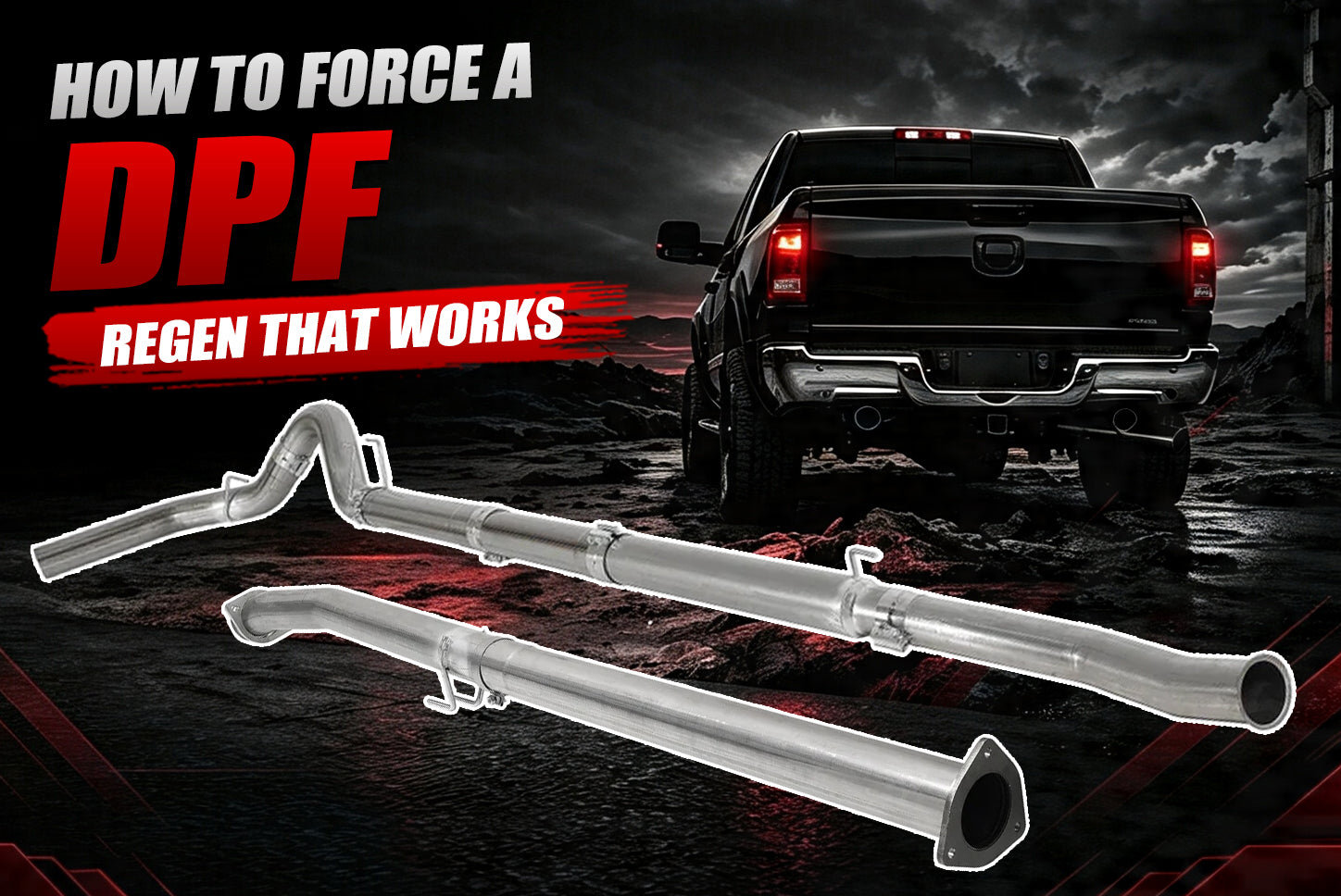
Turbo-back means exactly what it says: the pipe starts at the turbocharger outlet flange and runs all the way to the rear of the truck. On a 2013-2018 6.7L Cummins, a 5-inch turbo-back DPF delete system replaces the factory downpipe, the DPF canister, the SCR catalyst, and all the intermediate tubing before the muffler or straight pipe tips.
The critical piece is the downpipe. The factory downpipe on the 2013-2018 Cummins drops from the turbocharger outlet — which is tight against the firewall on the passenger side — and makes an immediate bend to route the exhaust under the cab. The stock pipe is approximately 3.5 inches in diameter and uses a crush-bent profile, meaning the inside diameter narrows at the bend radius where the metal compressed during manufacturing. Every molecule of exhaust gas leaving the turbo passes through this section before reaching the DPF.
A turbo-back delete replaces this factory downpipe with a mandrel-bent section that flows into the full-diameter 5-inch pipe immediately after the bend clears the firewall. No crush, no diameter reduction, no restriction between the turbo and open air.
The 2013-2018 Ram 6.7L Cummins 5" Turbo-Back DPF Delete Exhaust from DieselTok includes every pipe section,and clamp needed to go from the turbo flange to the tailpipe in one bolt-in kit. For trucks where some sound moderation is preferred, a version with a 5-inch performance muffler is also available.
What a Downpipe-Back Pipe Covers — and What It Doesn’t
Downpipe-back means the pipe starts at the flange below the factory downpipe. It replaces the DPF canister, the SCR catalyst, and the downstream exhaust tubing — everything after the factory downpipe but not the downpipe itself.
On the 2013-2018 6.7L Cummins, the factory exhaust system is segmented. The downpipe bolts to the turbocharger outlet at the top and terminates at a flange approximately level with the transmission crossmember. From that flange back, the DPF canister assembly contains the diesel particulate filter, the SCR catalyst, and the intermediate tubing. The downpipe-back delete replaces the entire assembly from that flange rearward, leaving the factory downpipe bolted to the turbo and untouched.
This is the simpler install. You are not fighting the turbo flange bolts at the back of the engine. You are not working inside the tight clearance between the firewall and the block. You unbolt the factory mid-pipe at the downpipe flange, remove the DPF and SCR assembly as a unit, and bolt the delete pipe in its place. Less time, fewer seized fasteners, and no risk of snapping a turbo flange stud.
The trade-off is that the factory downpipe stays. Its 3.5-inch crush-bent profile remains the narrowest section of the entire exhaust system, sitting directly downstream of the turbo where exhaust gas velocity and temperature are highest.
The Price Difference: What That Extra Money Buys
A turbo-back kit costs more than a downpipe-back kit because it includes one additional piece: the downpipe section itself. That single pipe section adds material cost — it is a complex bend fabricated to tight tolerances — and the flanges and hardware that go with it.
At the time of writing, DieselTok’s 5-inch turbo-back delete for the 2013-2018 Cummins is priced approximately $50 to $70 higher than the equivalent downpipe-back system, depending on whether a muffler is included. That price gap is almost entirely the downpipe and its associated mounting hardware. For the cost of a tank and a half of diesel, you get a mandrel-bent pipe that eliminates the last factory restriction in the exhaust path.
For trucks running a stock tune with no additional fueling modifications, the flow difference between the factory 3.5-inch downpipe and a 5-inch mandrel-bent replacement is measurable but modest — the DPF and SCR catalyst are far larger restrictions, and removing them accounts for the bulk of the performance gain. For trucks with a tune that adds fuel, a larger turbo, or injectors, the factory downpipe becomes a genuine bottleneck. Turbo-back is the only configuration that removes it.
Installation: The Real Difference in Your Driveway
The install time gap between turbo-back and downpipe-back on a 2013-2018 Ram 2500 or 3500 is significant enough to influence which kit you choose.
A downpipe-back install is the straightforward job. Remove the factory DPF and SCR assembly — typically three to four flange connections and a few hanger brackets. The delete pipe bolts into the same flanges using the same mounting points. Plan for two to three hours on jack stands with basic hand tools. The hardest part is maneuvering the factory DPF canister out from under the truck without dropping it on yourself — the canister is heavy and awkward.
A turbo-back install adds the downpipe swap to the job. The turbocharger outlet on the 2013-2018 Cummins is at the back of the engine, tight against the passenger-side firewall, above the transmission bellhousing. The mounting flange uses two or three studs that have been heat-cycled thousands of times. Access is from underneath with a long extension and a swivel socket, working around the transmission tunnel and the firewall pinch weld. Penetrating oil the night before is mandatory. A seized or snapped turbo flange stud turns a bolt-on job into an extraction.
Plan for four to five hours for a turbo-back install on jack stands. The extra time is the downpipe R&R — removing the factory pipe, fitting the new one into the same tight space, and torqueing the turbo flange bolts to spec without cross-threading them in a position where you cannot see the threads.
The one scenario where a turbo-back install gets significantly easier is if the transmission crossmember is already dropped for a transmission service or clutch job — with the crossmember out of the way, the downpipe bolts are reachable with straight extensions instead of swivels, and the extra time shrinks from two hours to maybe 45 minutes.
Conclusion
The decision between turbo-back and downpipe-back for a 2013-2018 6.7L Cummins comes down to one question: is the factory downpipe a problem you need to solve right now?
If the truck is on a stock tune and the goal is eliminating the DPF and SCR for reliability and reduced backpressure, a downpipe-back delete does 90 percent of the job for less money and less wrench time. The factory downpipe is not optimal, but it is not actively hurting you on a stock fueling map.
If the truck has a tune, larger injectors, or an upgraded turbo, the factory downpipe is the bottleneck that limits the benefit of every other modification. A 5-inch turbo-back system removes every restriction between the cylinder head and the tailpipe. That extra $50 to $70 buys you the last piece of the puzzle, and it is far easier to install the downpipe once than to pull the truck apart again later.
DieselTok carries both configurations for the 2013-2018 6.7L Cummins in 5-inch, with and without a performance muffler, all mandrel-bent and bolt-in. You can see the full 6.7L Cummins exhaust lineup at www.dieseltok.com.

FAQ
Is a turbo-back delete louder than a downpipe-back delete?
At the same pipe diameter, the difference is negligible. The downpipe is upstream of the muffler or straight tailpipe, and the sound character is determined by pipe diameter and whether a muffler is installed, not by whether the downpipe is factory or aftermarket. A 5-inch turbo-back with a muffler will be quieter than a 5-inch downpipe-back without one.
Will I throw a check engine light with either pipe?
Yes, if the truck is not tuned. Removing the DPF and SCR will trigger P2002, P2458, P2459, and several SCR-related codes within minutes of startup. A delete-capable tune must be installed to suppress these codes. The pipe kit itself is mechanical — the tuning is a separate requirement regardless of whether you choose turbo-back or downpipe-back.
Does the factory downpipe rust out on the 6.7L Cummins?
Not as aggressively as on some other diesel platforms. The 6.7L Cummins downpipe is stainless steel from the factory on most model years, and it is upstream of the DPF where exhaust temperatures are high enough to keep moisture from condensing and pooling. Corrosion failure is uncommon. The reason to replace it is flow, not rust.
Can I run a 5-inch downpipe-back kit and upgrade to turbo-back later?
Theoretically yes, but the downpipe section is not typically sold as a standalone piece from most manufacturers. You would be buying a second full kit to get one pipe. If you think you might want the downpipe later, buy the turbo-back kit now and install everything. It is cheaper than buying twice.
What about the 4-inch vs 5-inch choice for the 2013-2018 Cummins?
The 2013-2018 6.7L Cummins has a 3.5-inch factory downpipe. A 4-inch delete system is a meaningful upgrade and will flow adequately for stock and mild tuning levels. A 5-inch system provides additional flow margin for aggressive tuning and reduces exhaust gas temperature at the tailpipe. The 5-inch systems are also deeper in tone. For most daily-driven trucks, a 4-inch system is sufficient — but if the truck is getting a tune, injectors, or a turbo upgrade, the 5-inch is the safer choice for EGT management.